A Knowledge Graph Without a Graph Database
A structured system you trust — a project registry, a launch tracker — links out to a design document. That design document links to a test report. The test report links to a dashboard guide. The dashboard guide links to something on the open internet.
Two questions fall out of that chain, and they’re the same question wearing different hats. Which of these documents belong in your search corpus? And of the ones that do, how much should each be trusted?
That is a graph problem. It is not, necessarily, a graph database problem — and the distinction is the subject of this post. In the system I’ve been drawing on throughout this series, a knowledge graph did real work: it decided what entered the corpus, how far the crawler went, how much of each document got indexed, and one of the ranking signals. It did all of that as edge tables and batch jobs in a warehouse, with no graph database anywhere.
I want to explain why that was the right call there, and — just as importantly — the conditions under which it would be the wrong call for you.
The graph already exists
The first thing to notice is that nobody decided to build a graph. Documents contain links. Structured sources reference documents. Those are edges, whether or not you ever draw them. The only real decision is whether you materialize them and what you do with them.
Which means the graph inherits everything from the identity work in the URL post. A graph is nodes and edges; if your node identity is a URL string, then the same document reached three ways is three nodes, your traversal counts them separately, your authority scores split three ways, and every conclusion you draw is wrong in a way that’s very hard to see. Canonical identity isn’t a prerequisite for the graph — it is the graph’s node definition. Get it wrong and no amount of graph sophistication downstream will recover.
With stable IDs in hand, the durable representation is boring: an edge table. Source-to-document edges and document-to-document edges, deduplicated, self-links excluded, each row carrying where it was observed. Boring is the point — it’s a warehouse table like any other, it joins to everything else, it versions with your other data, and it can be rebuilt from scratch the same way the index itself is rebuilt.
Bounded breadth-first expansion
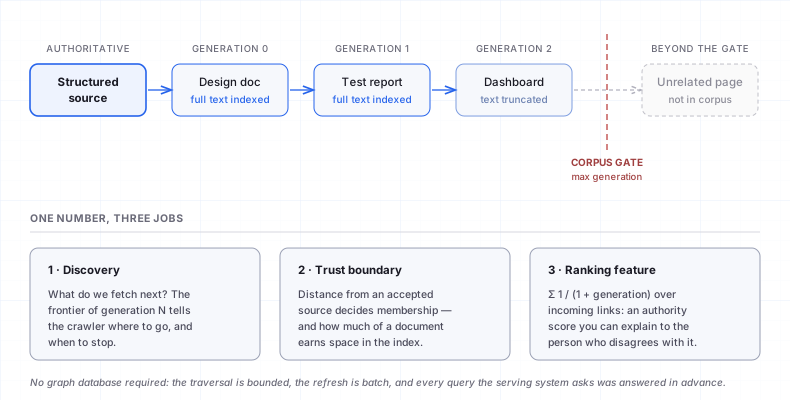
The traversal that matters is deliberately simple: a bounded breadth-first walk out from the sources you trust.
generation 0 = documents referenced directly by an authoritative source
generation 1 = not-yet-seen documents linked from generation 0
generation 2 = not-yet-seen documents linked from generation 1
…
stop at a small fixed depth
Each document gets a shortest generation — the fewest hops from any accepted source — plus one concrete path back to a source that produced it. In batch, this is a handful of joins repeated a fixed number of times; the “not-yet-seen” condition is what keeps it terminating and what makes each document’s generation the shortest one. Cycles, which are the classic hazard of link graphs, stop being a hazard: a document already mapped in an earlier generation is simply never remapped.
Note what fixed depth buys beyond termination. It’s a statement of editorial policy in the shape of an integer. Three hops from a trusted registry is still, plausibly, work product. Eight hops is the entire internet. The depth limit is where somebody decides how far “related to what we do” extends, and writing it as a number in a config makes that judgment reviewable instead of emergent.
One number, three jobs
Here’s what I find genuinely elegant about this design, and it took me a while to appreciate: the generation number does three different jobs at once, and they reinforce each other.
It drives discovery. The frontier — the documents just added at generation N — is exactly the fetch list for the next pass. The graph tells the crawler where to go, and the depth limit tells it when to stop. Discovery isn’t a separate system with its own notion of scope.
It draws the trust boundary. The corpus gate is a predicate on generation: a document is included only if it’s within the maximum accepted distance from a source. This is a genuinely different way to think about corpus construction. Instead of asking “is this document good?” — which requires judging content — you ask “is this document connected to something we already decided was authoritative, closely enough?” Provenance as membership criterion.
It’s a ranking feature. Distance from a trusted source is a reasonable prior on how much a document should be believed, and it feeds a simple authority score I’ll come back to in a moment.
And then there’s a fourth use that I think is the cleverest thing in the system, because it turns a trust policy into a cost control. How much of a document’s text gets indexed can itself scale with generation. Documents close to an authoritative source contribute substantially more text to the index; distant ones contribute a truncated version. Think about what that accomplishes in one move: index size is bounded, retrieval quality is protected where it matters most, and the corpus can be generous at its edges without letting marginal documents consume the same resources as core ones. It’s not “in or out” — it’s a graded membership, where the graph decides how much space you earn.
That’s the kind of design that only appears when the graph and the index are built by the same pipeline. A general-purpose graph database sitting off to the side would have made this awkward to even express.
Authority you can explain
For a ranking signal, the system used a deliberately unsophisticated score:
score(document) = Σ over incoming links of 1 / (1 + generation(linking document))
A link from a document sitting right next to an authoritative source counts for a lot. A link from something four hops out counts for little. Sum them up. That’s the whole feature.
This is not PageRank, and the difference is the point. PageRank is a global eigenvector computation over the entire graph — beautiful, well-understood, and opaque in exactly the way that hurts when someone asks why their document ranks below another one. The generation-weighted score can be explained to a skeptical colleague in one sentence, and — more usefully — audited: you can list the specific incoming links that produced the number and see immediately whether they look like endorsements or noise.
I’d defend that choice generally. In enterprise corpora, interpretable authority features usually beat sophisticated ones, for a reason that’s structural rather than mathematical: the corpus is small enough that a handful of weird links can dominate a global algorithm, there’s no adversary you’re defending against, and the people who complain about ranking have standing to demand an explanation. Global graph algorithms earn their keep on the web, where the graph is enormous, adversarial, and nobody gets to appeal.
(The production index did also carry a PageRank field, computed by a separate producer that I never worked on and won’t describe. Worth knowing it existed; I can’t tell you what it contributed.)
What a link actually means
The largest intellectual honesty problem in all link-based systems, and the one I’d want stated plainly in any design doc that proposes one:
A hyperlink is not an endorsement. It might be navigational (“back to index”). It might be critical (“this proposal is wrong, see here”). It might be obsolete, pointing at a document deprecated two years ago. It might be boilerplate in a template that appears on ten thousand pages. Treating link structure as a semantic relationship — “these documents are about related things, and this one vouches for that one” — is an approximation that is frequently, specifically false.
What the graph path genuinely is, and all I’d claim for it, is provenance: a record of how this document was found and what it hangs off. That’s an honest and useful thing. It supports “this was reachable from a launch tracker in two hops,” which is a real statement about a document’s context. It does not support “this document is endorsed by that tracker,” and systems that quietly upgrade the first claim into the second produce ranking that feels arbitrary — because it is.
The graded-text-budget idea above is a good example of respecting that limit. It uses graph distance to allocate resources, which is a defensible use of a weak signal, rather than to assert relevance, which would be overreach.
Why no graph database was needed
Step back and look at what was actually required of the graph, and the absence of a graph database stops looking like an omission:
- The traversal was bounded and known in advance. Breadth-first, from fixed roots, to a fixed depth. That’s not arbitrary traversal — it’s a fixed-iteration batch job.
- Freshness requirements were batch-shaped. The corpus is recomputed on a schedule. Nothing needed a millisecond answer to a graph question.
- The consumer wanted flat features, not paths. By serving time, the index needed a generation number, a path string, some counts, and a score — scalars on a document, precisely as the projection model predicts. Nobody queried the graph at request time. The graph’s entire output was five or six columns.
- The data was already in the warehouse. The edges came from the same pipeline as everything else. Adding a graph database would have meant another system to sync, secure, monitor, and reconcile — for computations that were already a few joins in Spark.
That last point is the real argument, and it generalizes past graphs. A new piece of infrastructure has to earn its keep against the cost of existing: another failure domain, another schema to evolve, another thing that can be stale in a way nobody notices. Precomputing five columns in a pipeline you already run is an enormously high bar for a new database to clear.
When you should buy one
I don’t want to leave the impression that graph databases are a mistake. There are conditions where the design above falls apart, and they’re recognizable:
Interactive traversal of arbitrary shape. If users compose queries you didn’t anticipate — “show me everything within three hops of this, filtered by type, sorted by recency” — you can’t precompute the answers, and you need an engine that traverses at query time.
Path queries as the product. If the path is what the user wants — shortest path between two entities, all routes between systems, cycle detection — that’s a graph database’s home turf, and expressing it as repeated joins is masochism.
Rapidly changing edges with tight freshness. Batch recomputation assumes the graph is stable between runs. If edges change constantly and those changes must be immediately visible, you want a store designed for incremental graph mutation.
Transactional graph updates. If edges must be written and read consistently as part of an application’s workflow, a batch projection isn’t a serving layer.
The Hulu platform I wrote about years ago is the counterexample in my own history — there, Neo4j and Cypher genuinely earned their place, because the questions being asked were interactive, arbitrary, and path-shaped: engineers troubleshooting a pipeline needed to explore dependency structure at 3am, not read a precomputed column. Same underlying data model, opposite access pattern, opposite conclusion.
That’s the test I’d apply, and it isn’t “how graphy is my data?” It’s: are the traversals bounded and known in advance, and can they be answered in batch? If yes, you have a graph modeling problem, and edge tables plus iterative jobs will serve you well. If no — if the questions are composed at query time — buy the database, because you’ll otherwise reimplement one badly.
The takeaway
Everything in this post follows from treating the graph the same way the series treats indexes: as a projection built to answer a specific, known set of questions. Bounded traversal, edge tables, a generation number doing quadruple duty, and an authority score simple enough to argue about.
The trap worth naming is the one where “we need a knowledge graph” becomes “we need a graph database,” and a team spends a quarter standing up infrastructure to compute what a batch job could have produced as five columns. A graph is a way of thinking about your data. Occasionally it’s also a purchase order — but only when the questions arrive faster than you can precompute the answers.
Next in this series: chunking as information architecture — the last projection decision before retrieval becomes a language-model problem.