From One-Off Index Jobs to a Paved-Road Library
The fifth time you write the same two hundred lines, you notice.
Configure a Spark session and the connector JARs. Derive cluster and authentication settings for whichever environment this is. Query a warehouse table. Create a physical index with mappings. Write the DataFrame through the connector. Change the index settings. Move an alias. Retain or delete the old indexes.
Every search index in the system needed those steps. Documents, entities, topics, onboarding content, internal data documentation — each had a workflow script, and each script contained its own slightly different copy of that sequence. Copy-paste with drift, which is the most expensive kind.
But the repetition that mattered wasn’t the syntax. It was the lifecycle —
and specifically the fact that the parts being retyped were the dangerous
parts. Anyone can rewrite a SELECT. What was being re-derived, five times,
with five sets of small variations, was the sequence that determines whether
a failed load takes down search. That’s the observation that turns “we have
some duplication” into “we need a library.”
This closes the first season of this series, and it’s the one post about organizations rather than systems: what happens when a pattern is understood well enough to be encoded, and what it costs to encode it.
Extract the lifecycle, not the function
The instinctive extraction is a utility: write_dataframe_to_index(df, name).
That’s the wrong seam. It factors out the easy part — the part nobody gets
wrong — and leaves every caller still hand-rolling the risky choreography
around it.
The right unit was the whole thing: give me SQL and a logical target, and I’ll give you a correctly swapped index. At Netflix I worked on a library that did exactly that, and the shape of its main entry point is most of the design:
load_sql_to_es(sql, alias, mappings=..., settings=..., options=...)
Behind that call sits the entire alias-swap lifecycle: timestamped physical index, mappings applied before the write, ingest-oriented settings during load, search settings restored after, one atomic alias move, previous index retained, older ones cleaned up.
The invariants it enforces are the ones a team learns the hard way:
- A rebuild always goes to a new physical index. Never mutate the live one.
- Mappings are applied at creation, before a single document is written, because afterward is too late.
- The alias moves exactly once, atomically.
- The previous index survives, so rollback is a pointer move.
Encoding those four rules is the library’s actual product. The Spark plumbing is incidental.
Two levels, and an escape hatch that’s real
The library had a low-level function and a streamlined wrapper on top. In its simplest form a caller could write something very close to:
es_load(f"SELECT * FROM {get_table('input')}")
Environment, cluster, credentials, and physical table names come from workflow parameters rather than from arguments — configuration lives in the control plane, where operations can see and change it, instead of being baked into application code.
That one-liner is the paved road. What makes a paved road usable, though, is that the shoulder is paved too. Every layer stayed overridable: mapping and settings overrides, extra Spark options, extra connector options, a deterministic ID field, multi-part loads for the big cases, and — crucially — the low-level function itself, callable directly when the wrapper’s assumptions don’t fit.
I’d state that as a rule: the escape hatch must be a supported interface, not a fork. The failure mode for internal platforms isn’t that someone needs to do something unusual; it’s that doing something unusual requires abandoning the library, at which point that team stops receiving every improvement and bug fix you ship afterward. A team using your low-level API in a weird way is still your user. A team that copied your module into their repo and edited it is a future incident.
Defaults are bets
Here’s the tension at the center of this kind of work, and I don’t think it resolves cleanly.
A default encodes learning. Somebody figured out — probably during an outage — that loading with replicas disabled and refresh turned off is dramatically faster, and that restoring them before cutover is essential. Now every job gets that for free, including jobs written by people who’ve never heard of a translog. That’s the whole promise of a paved road: the tenth team gets the first team’s scars without the bleeding.
But every one of those defaults is a bet about a workload, and the bet is invisible at the call site.
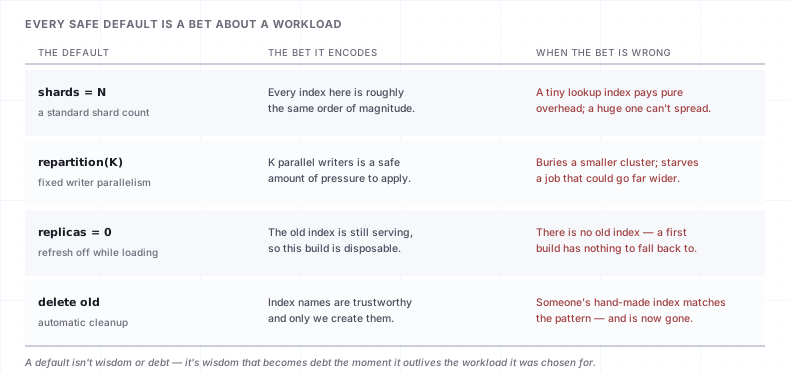
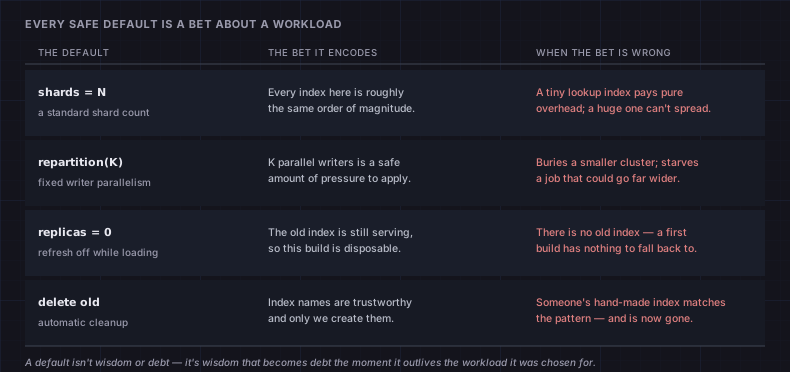
Take the last row, which is my favourite because it’s the one where the library’s convenience and its danger are literally the same feature. Automatic cleanup of old physical indexes is what keeps a cluster from filling with the residue of a year of rebuilds. It works by matching a naming pattern. Which means the naming convention is load-bearing safety machinery, and if anyone ever creates an index by hand that happens to match it, the library will eventually delete their index, correctly, per its rules.
Or the third row: aggressive ingest settings are safe because the old index is still serving. That reasoning is airtight for a rebuild and doesn’t hold for a first-ever build, where there’s no predecessor to fall back on. Same default, same code, materially different risk — determined by a fact the library doesn’t check.
So the resolution I’d offer isn’t “choose better defaults.” It’s:
A default is wisdom that becomes debt the moment it outlives the workload it was chosen for. Write the assumption down next to the value.
Which is the same lesson as the freshness post, arriving from a completely different direction — there it was a policy whose justification expired; here it’s a default whose justification was never written down in the first place. Both fail silently, and both are cheap to prevent with a sentence of prose next to the number.
Make the dangerous things loud
Two operations in this library deserved to be harder to invoke than the rest: deleting old indexes, and multi-part loads that append to an existing target with upsert semantics instead of rotating a fresh one.
Both are legitimate. Both also break the mental model the rest of the library establishes — builds are immutable and disposable — and a caller skimming a config option may not notice they’ve opted out of the safety property that makes everything else defensible. Anything that removes data or mutates a live target should be verbose at the call site, loud in the logs, and impossible to enable by accident.
Compatibility is part of your API
The most underrated line item in internal-library work: this library’s real interface included Python, Spark, the JDK, the Elasticsearch-Hadoop connector, the client library, and the server version — a compatibility matrix, most of which appears nowhere in the function signature.
Upgrade Spark and the connector may not support it. Upgrade the cluster and the client may go out of range. Every caller inherits that matrix whether or not anybody documented it, and the library owner becomes the person who absorbs those transitions on everyone’s behalf. That work is unglamorous, invisible when it goes well, and is a large fraction of what it actually means to own a paved road. Budget for it, or the road silently becomes unmaintained and teams start driving around it.
Testing something that only does side effects
This kind of library is nearly all side effects: create, write, mutate settings, swap, delete. There’s very little pure logic to unit test, which is exactly why it’s tempting to test nothing and rely on it working in production.
The seam that makes it testable is separating decisions from effects. What physical name should this build get? Which index currently holds the alias? What alias actions does the swap require? What’s the deletion set under this retention policy? Each of those is a pure function you can test exhaustively — especially the deletion set, where the test you want is the one asserting that an index not matching the pattern is never selected, and that an aliased index is never selected regardless.
Then the effects layer is a thin adapter over the client, and it’s the only part that needs an integration environment. The bugs that hurt in this lifecycle are decision bugs — wrong name, wrong swap, wrong deletion — and those are the ones this split lets you catch cheaply.
What I’d add now
The gap I’d close first is the one I flagged in the rebuild post: a real validation gate before cutover. Row-count floors, source-to-index reconciliation, distinct ID counts, mapping version, settings actually restored, smoke queries — with failure blocking the alias move rather than logging a warning. A library that owns the swap is the perfect place to own the gate, because it’s the one component that knows both what was intended and what landed. Every caller would inherit it for free, which is precisely the argument for the library in the first place.
After that: consistent structured metrics on every load (duration, counts in and out, rejections, which settings were applied), so that “is the index healthy?” is answerable from the same telemetry everywhere instead of per-team archaeology.
Two ways to encode expertise
It’s worth contrasting this with the other approach to the same problem, which I’ve also built. Years earlier, on Hulu’s data platform, we tackled “lots of teams need to do a similar thing” with a domain-specific language and an embedded expression language — give people a constrained vocabulary and let them express their own logic inside it.
That’s the right move when your users aren’t the platform’s engineers and shouldn’t have to be: a DSL trades expressiveness for accessibility, and its ceiling is deliberate. A library is the right move when your users are engineers who could write the code themselves and shouldn’t have to write the risky part again. The DSL constrains what can be expressed; the library standardizes how something dangerous gets done. Different audiences, different failure modes, same underlying instinct — encode the expertise once, in the place where it can be improved for everyone.
Closing the season
The most valuable thing that library did was not sending rows to Elasticsearch. It was making the lifecycle of a derived projection boring, repeatable, and reversible.
That sentence also sums up the season. We started with the claim that a search index is a projection rather than the truth, and everything since has been a consequence of taking that seriously: if the index is derived, you can rebuild it fearlessly; if it’s assembled from many sources, you need canonical identity and an explicit policy for when you can’t confirm what you have; its entity and graph features are projections too; and chunking is the projection decision that determines what can be found at all.
A library like this is what that worldview looks like once an organization believes it. Not an abstraction over Elasticsearch — an assertion that building, validating, swapping, and retiring derived data is a known procedure rather than something each team improvises. That’s the payoff of the whole projection framing: it turns the scariest operations in a search system into a paved road, and then into something nobody thinks about on a Tuesday.