Growing a Daily Puzzle Curriculum (with an AI on a Monday-Morning Cron)
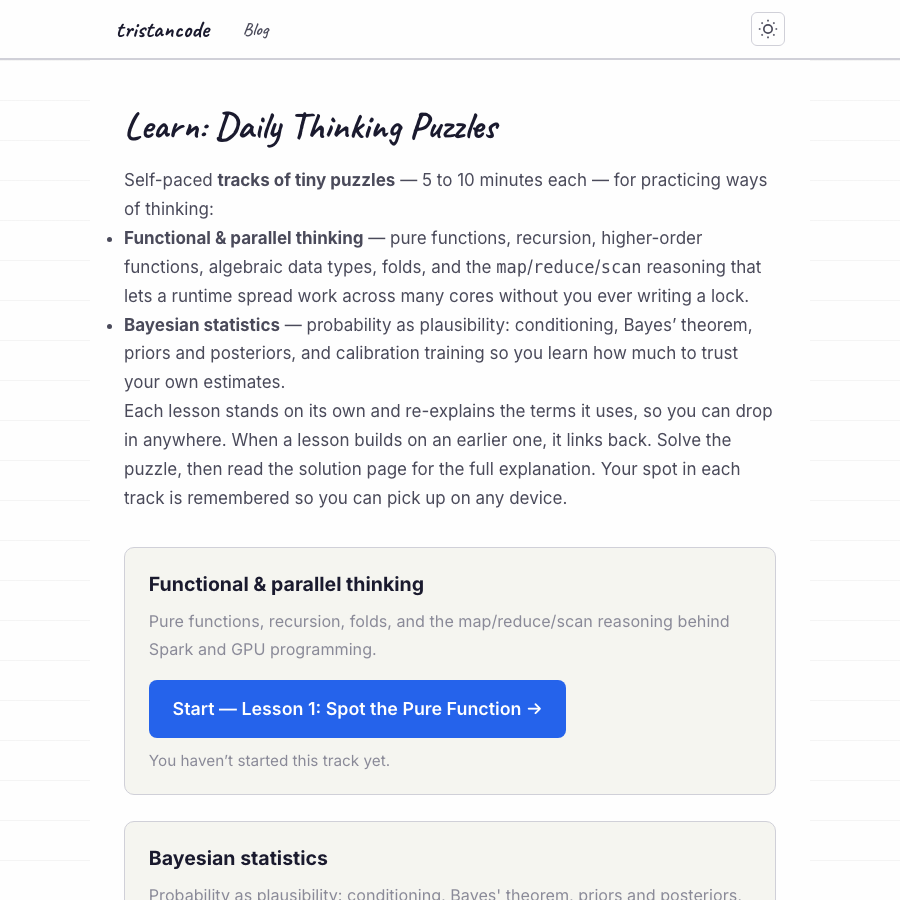
This is an experiment that’s still running: a self-paced path of tiny daily puzzles at tristancode.com/learn, which an AI routine extends every Monday morning, staying a fixed distance ahead of wherever I actually am. As I write this there are 86 puzzles live across four tracks, and I didn’t write them — I wrote the curriculum, the rules, and the feedback, and Claude Code writes the lessons.
Two things make this worth a post: the learning-theory choices (why puzzles, why these answer formats, why these topics), and the engineering contract that makes unattended AI generation something other than a content firehose.
Why puzzles, not articles
The format rule for the whole site is: you attempt before you see. Every lesson leads with a puzzle; the solution is a separate page you visit after committing to an answer.
That’s not a style preference — it’s the most robust result in the learning literature. The testing effect: retrieving (or even just attempting) an answer strengthens memory far more than re-reading an explanation, and the attempt helps even when it fails, because it primes you for the correction. An article invites you to nod along; a puzzle makes you discover what you actually believe first, so the explanation lands on a live question instead of a blank slate.
The answer formats form a ladder, each rung demanding a stronger commitment before the reveal:
- Reveal — think, then flip. The weakest commitment, for questions where the thinking is the point.
- Multiple choice — commit to one of several plausible wrongs.
- Numeric — type an actual number, checked with a tolerance (with the solution unlocking after three misses, so a stuck puzzle can’t dead-end).
- Estimate — the interesting one. It deserves its own section.
Calibration: the estimate puzzle
An estimate puzzle asks for two things: your best single guess, and a 90% interval — a low and high bound you believe has a 90% chance of containing the true value.
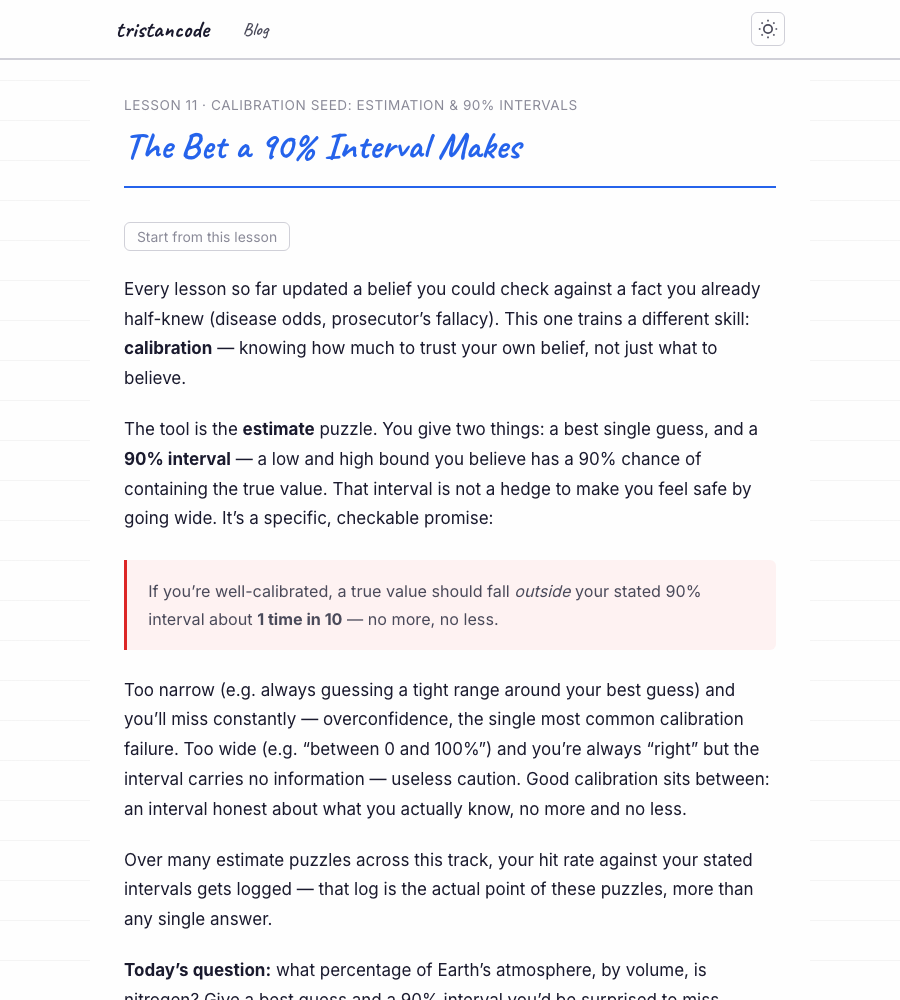
The interval is not a hedge. It’s a specific, checkable promise: if you’re well-calibrated, the truth should escape your 90% intervals about one time in ten — no more and no less. Miss constantly and you’re overconfident (the single most common human failure). Never miss and your intervals are useless caution — “between 0 and 100%” is always right and carries no information.
Every estimate answer gets logged, so the site accumulates a record of my hit rate against my stated intervals over months. That long-run log — not any single answer — is the real product. You’re not just learning what’s true about the world; you’re learning the transfer skill underneath every forecast and every project plan: how much to trust your own confidence.
The four tracks, and why these
Topics weren’t picked to be a syllabus; each track exists because of a specific itch. Tracks are cheap to add — a curriculum file and a one-line registry entry — so the system follows curiosity:
- Functional & parallel thinking (the original) — pure functions, recursion, folds, algebraic data types, and the map/reduce/scan reasoning that lets a runtime spread work across cores without you writing a lock. Honest origin story: this started as an on-ramp to the Bend language, and partway in I realized the language was scaffolding — the concepts were the destination. The track got deliberately de-anchored, and I think it’s better for it. Curricula, like trip routes, deserve re-planning.
- Bayesian statistics — probability as plausibility: conditioning, priors and posteriors, and the calibration training above. This is thinking-tool maintenance; it decays without reps.
- Cognitive science & AI architectures — the personal one. I’d built an agent harness inspired by blackboard systems and wanted the intellectual lineage under my feet: production systems, Hearsay-II, ACT-R and SOAR, subsumption, Society of Mind — arriving at modern agent harnesses knowing which sixty-year-old ideas they’re re-discovering.
- Machine learning — deliberately sequenced with evaluation before neural nets: baselines, leakage, metrics, and how to tell whether a model is any good, before any architecture worship.
The buffer: generation throttled by progress
The scheduling rule that makes the whole thing sane: the routine keeps exactly eight unsolved lessons ahead of my last-completed marker in each active track. Never more.
Small rule, three jobs. It means generation is demand-pulled by actual learning — if I stop solving, the queue stops growing, instead of piling up into a guilt mountain (every abandoned RSS reader knows this failure mode). It caps cost and review burden. And it keeps the generator working close to the frontier of what I’ve seen, where my feedback about quality is freshest. The Monday-morning routine’s whole job is: read each track’s marker, count unsolved lessons ahead, top up to eight, publish.
Letting an AI write lessons unattended
The generator is a scheduled Claude Code task. The interesting design isn’t the generation — it’s the contract that keeps weekly unattended output coherent:
- Curriculum as source of truth. A public repo (tristanreid/daily-learning-puzzles) holds per-track curricula, the generation prompt, and a feedback file. The routine re-reads all three every run — so when I correct course (“less jargon,” “that lesson assumed notation I never introduced”), the correction is written down once and applies to every future lesson, not just the next one. The AI has no memory between Mondays; the repo is the memory.
- Config, never code. Lessons are markdown with front matter; the answer types are driven entirely by front-matter fields. The generator is not allowed to write JavaScript. Interactive machinery gets built by hand, in sessions where I’m paying attention; the weekly routine can only fill in vetted shapes. This one rule removes the scariest failure modes of auto-published content.
- Boring, inspectable infrastructure. The site is static Hugo; progress
sync is one small serverless function writing
{lastCompleted, events}to a blob store, keyed by an anonymous token in the URL — no accounts, no logins, and a progress record I can read with curl.
One war story from the seam between those pieces: after a big restructure, the site served new HTML against a ten-day-cached copy of the old JavaScript, and every lesson page hung on “Loading your spot…”. Nothing was wrong with the generated content — the deploy pipeline had outrun the cache policy. When an AI ships while you sleep, the boring web fundamentals (cache-busting, versioned assets) stop being optional hygiene and become the safety rail.
The feedback loop, and what’s next
Completing a lesson isn’t a checkbox — it’s a one-tap difficulty rating: easy / good / hard / fail. Combined with the estimate logs, the site is quietly accumulating outcome data about me: which concepts I rate hard, where my calibration drifts, what I fail.
That’s the open frontier. The designed-but-unfinished half feeds those signals back into generation: per-concept weakness maps, spaced review of what I got wrong, probes at the boundary of what I’ve mastered. The honest summary of where this experiment stands: the generation loop is closed and has run for months; the adaptation loop is still mostly a design document.
Which suggests the real takeaway. The interesting artifact here isn’t an AI that writes puzzles — that part is almost easy now. It’s the contract around it: a curriculum it must follow, a buffer that throttles it, ratings that inform it, and a config-not-code boundary that limits it. Same lesson as the canoe maps, one scale up: the human contribution isn’t the artifact, it’s the specification — and here, the specification is a living thing the AI and I maintain together, one Monday at a time.