A URL Is a Locator, Not an Identity
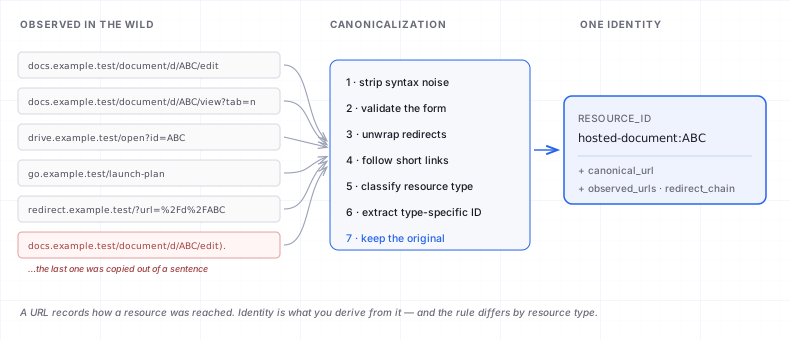
Here are five strings. They all point at the same document.
https://docs.example.test/document/d/ABC/edit
https://docs.example.test/document/d/ABC/view?tab=notes
https://drive.example.test/open?id=ABC
https://go.example.test/launch-plan
https://redirect.example.test/?url=https%3A%2F%2Fdocs.example.test%2Fdocument%2Fd%2FABC
One person opened it from a file browser. One followed a company short link. One pasted it out of an email that routed through a click-tracking wrapper. One was reading the notes tab. They are five different observations of how someone got there — and exactly one document.
If your pipeline treats those as five documents, here’s what you’ve actually
built: a search result page with the same document listed five times, each
copy holding one-fifth of the evidence about how important it is. The link
graph splits into five weakly-connected nodes instead of one well-connected
one. Freshness checks refresh five records, disagreeing about which is
current. Five near-identical chunks land in your vector store, so a RAG
retrieval that wanted three distinct sources gets one document wearing three
hats. And when a colleague reports that “the launch plan doesn’t come up,” you
will spend an afternoon confirming that it does, in fact, come up — as
hosted-document:ABC-but-with-a-tab-parameter, ranked forty-first.
This post is about the step that prevents all of that: deriving a canonical identity for the things in your corpus, and understanding that URLs are evidence toward that identity rather than the identity itself.
It’s the third post in a series arguing that a search index is a projection, not the truth, and that most retrieval failures are manufactured upstream of retrieval. Identity is the purest example of that claim I know.
Identity is not a string comparison
Every engineer’s first instinct here is a normalize_url() function:
lowercase the host, drop the fragment, sort the query parameters, strip the
trailing slash. Write it once, use it everywhere.
That function is worth having and it will not be sufficient, for a reason worth stating precisely: the rule for extracting identity depends on what kind of resource you’re looking at.
- For a hosted document, the identity is an opaque ID embedded in the path,
and everything else —
/edit,/view,?tab=notes— is a view of it that should be discarded. - For a dashboard, the URL may name a specific view inside a workbook, and the identity you actually want is usually the workbook.
- For a web application, identity may be the host itself, since the paths are ephemeral UI state.
- For a file in a source repository, the full path is the identity — the
repository is far too coarse, since
README.mdanddocs/setup.mdare entirely different documents that a repository-level ID would merge into one.
Notice that last one runs in the opposite direction from the others: three rules say “throw away path detail,” and one says “keep all of it.” No generic normalizer can know that, because it isn’t a fact about URL syntax. It’s a fact about the systems those URLs come from. This is the crux of the post: identity is domain knowledge, not string processing — and it belongs in a classification step that says “this is a hosted document” before it says “therefore its ID is this part.”
The stages
A canonicalization pipeline that survives contact with real corpora ends up with roughly seven stages, and they have to happen in this order.
1. Extract URLs from text. Links don’t arrive as tidy fields; they arrive embedded in prose, in chat messages, in structured fields that sometimes contain a sentence, in nested JSON blobs. You need a URL matcher that can find candidates anywhere, including inside arbitrarily nested structures.
2. Strip syntax noise. URLs copied out of prose bring the prose with them: a trailing period, a comma, a closing parenthesis, a quotation mark, sometimes an invisible non-printing character. This step is unglamorous and it is where an outsized share of bugs live. More on that in a moment.
3. Validate the form. Reject what isn’t a supported URL: malformed strings, domains you deliberately exclude, schemes you don’t handle. Better to drop it here, explicitly, than to have it fail mysteriously three stages later.
4. Unwrap redirect wrappers. Click-trackers and safety scanners encapsulate the real URL as a query parameter. That’s a pure string operation — the true target is right there, percent-encoded — and it’s worth doing before you make any network calls.
5. Resolve short links, with a bound. A short link (go/launch-plan) is
a promise that only the resolver can keep, so this stage does I/O. Which
means it needs the full defensive kit: cache aggressively (the same handful
of aliases appear constantly), rate-limit the resolver so your batch job
doesn’t take out an internal service, follow at most a small fixed number of
hops, and persist the resolution status alongside the result so a failure
is a recorded fact rather than a silent absence. Short links pointing to
short links are common enough to matter, and short link cycles exist. A hop
limit isn’t paranoia; it’s the difference between a bounded job and one that
hangs.
6. Classify the resource, then extract its ID. The type-specific step from the previous section. Classification first, identity second.
7. Keep the original. Deriving a canonical ID is lossy, and you will want the loss back. Store the observed URLs and the redirect chain alongside the canonical record:
{
  "resource_id": "hosted-document:ABC",
  "canonical_url": "https://docs.example.test/document/d/ABC",
  "observed_urls": [
    "https://docs.example.test/document/d/ABC/edit",
    "https://docs.example.test/document/d/ABC/view?tab=notes",
    "https://drive.example.test/open?id=ABC",
    "https://go.example.test/launch-plan"
  ],
  "redirect_chain": [
    "https://go.example.test/launch-plan",
    "https://docs.example.test/document/d/ABC/edit"
  ]
}
Provenance earns its storage three ways. It’s how you debug (“why did these two merge?”), it’s how you re-derive identity when a rule changes without re-crawling the world, and it’s how a user who searched for the short link they remember still finds the document.
The closing parenthesis that broke the graph
The stage-2 bugs are the ones I want to dwell on, because they illustrate something about pipelines that I think is underappreciated.
Someone writes, in a design doc:
See the launch plan (https://docs.example.test/document/d/ABC/edit).
Your extractor pulls out https://docs.example.test/document/d/ABC/edit). —
with the closing parenthesis and the period attached. Now trace what happens
downstream, one step at a time. The canonical ID derived from that string
doesn’t match the real document’s ID, so it becomes its own resource. Fetching
it fails, because that URL doesn’t exist. The edge from the design doc to the
launch plan is never created. The launch plan therefore has one fewer
incoming link — and if the design doc was its only inbound link from a
trusted source, the launch plan now sits outside the boundary of your
discovery graph entirely. It isn’t in the corpus. It cannot be returned.
The user’s experience of this: “search is bad.” The actual defect: one character of punctuation, five stages upstream, in a regex.
I’ve watched versions of this play out more than once, and the general lesson has stuck with me harder than any specific fix: in a retrieval pipeline, ingestion defects don’t announce themselves as ingestion defects. They present as relevance problems. A missing document produces no error anywhere — it’s an absence, and absences don’t page you. This is why I’d argue corpus-construction code deserves the same testing rigor as ranking code, even though ranking gets all the attention.
Test it like a parser, because it is one
Canonicalization is the rare pipeline component that’s trivially unit testable — it’s a pure function from string to identity — so there’s no excuse for not having a table of cases that grows every time something surprises you:
| Raw input | Expected type | Expected stable ID | Why |
|---|---|---|---|
.../document/d/ABC/edit | hosted document | hosted-document:ABC | drop the view suffix |
.../document/d/ABC/edit). | hosted document | hosted-document:ABC | strip trailing punctuation |
.../document/d/ABC/view?tab=notes | hosted document | hosted-document:ABC | drop view params |
go.example/launch-plan | short link → document | hosted-document:ABC | resolve the chain |
.../dashboard/workbooks/42/views/7 | dashboard | dashboard:42 | workbook is the identity |
.../repo/docs/setup.md | repository file | full normalized path | repo ID is too coarse |
https://excluded.example.test/x | excluded | (none) | rejected on purpose |
Every row in a table like this should be a bug someone actually hit. Written that way, the table becomes a compact history of everything your corpus has taught you about the systems it draws from — which is a genuinely valuable artifact, and one that transfers to the next person far better than the regex does.
Identity is a decision, and decisions change
One more property, easy to miss until it bites: identity is a policy you chose, which means it can change — and changing it rewrites history.
Suppose you decide dashboards should be identified by workbook rather than by individual view. That’s almost certainly an improvement. It also means documents that were previously five separate resources are now one, and any downstream artifact keyed by the old identity — index documents, graph edges, embeddings, cached summaries, a user’s saved link — refers to something that no longer exists.
Which is where this connects back to the
previous post on rebuilds: an
identity change is exactly the kind of change that’s trivial if you can
rebuild your index from a warehouse, and terrifying if you can’t. If
canonicalization is a pure function applied during a rebuild, changing the
rule is a code change plus a rebuild. If identity was assigned once, at crawl
time, and never recorded how it was derived, changing the rule means a
migration with no ground truth to migrate from. This is the practical
argument for keeping observed_urls around: it’s the raw material that makes
re-derivation possible.
The general form of that idea: derive identity, don’t assign it. A derived identity can be recomputed when your understanding improves. An assigned one is a fact you can no longer question.
What to take from this
If you’re building a corpus out of things that have URLs:
- Treat a URL as an observation, not a name. The name is what you derive.
- Classify before you identify. The rule differs by resource type, and sometimes runs in the opposite direction (keep the whole path, don’t strip it).
- Do string work before network work. Unwrap redirect wrappers before you resolve short links, and bound every chain you follow.
- Persist status, not just success. A failed resolution is data.
- Keep the originals. Provenance is what lets you change your mind later.
- Test canonicalization like a parser, with a table of real cases, because a one-character error here surfaces as “search is bad” and nowhere else.
None of this involves ranking, models, or anything a reader would call “search technology.” That’s rather the point. Retrieval quality is decided by whether your system knows what things are long before it decides which of them to show.
Next in this series: what to serve when the source of a document goes dark — freshness policy, failed reads, and a decision I got wrong and later deliberately reversed.